
Your portable power station is dying. Runtime keeps dropping. The battery meter shows full but shuts off at 30%. You’re staring at a tough decision: can I replace just the battery, what will it cost, and is replacement even worth it versus buying new?
Understanding power station battery replacement cost is the difference between wasting money on a bad repair and making a smart financial decision. Sometimes battery replacement makes perfect sense. Sometimes it’s throwing money at a lost cause. Sometimes official service is the only safe path. Sometimes DIY saves hundreds.
This guide gives you real power station battery replacement cost numbers by brand and capacity, explains exactly when replacement beats buying new, compares DIY versus professional service with actual pricing, and hands you a decision framework you can use today.
If you want to estimate how much runtime your degraded battery still delivers, use the power station runtime calculator to model current capacity.
When battery replacement becomes necessary (the real warning signs)
Not every capacity drop means you need to think about power station battery replacement cost. But certain thresholds and symptoms signal genuine end-of-life.
Capacity retention decision points
| Capacity remaining | Real-world experience | Replacement urgency |
|---|---|---|
| 90–100% | Feels like new | No replacement needed |
| 80–90% | Slightly shorter runtime | Acceptable for most users |
| 70–80% | Noticeably reduced runtime | Consider if mission-critical use |
| 60–70% | Significantly degraded performance | Strong replacement candidate |
| Below 60% | Barely functional for original purpose | Replace or retire unit |
Most manufacturers define warranty “end of life” as 80% capacity retention. But 80% doesn’t mean unusable—it means the warranty typically expires there.
The real question:
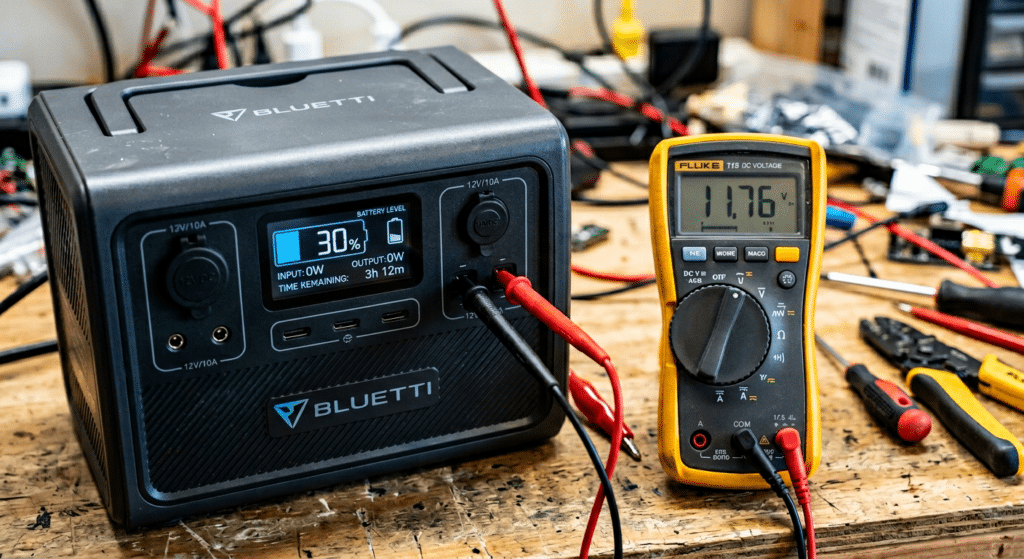
If your 1,500Wh station now delivers 1,050Wh (70% retention), ask yourself: “Does 1,050Wh still meet my actual needs?” If yes, keep using it. If no, it’s time to evaluate power station battery replacement cost seriously.
For understanding what causes degradation, see battery degradation power station prevent and LiFePO4 battery cycle life power station.
Non-capacity failure modes (when replacement becomes urgent)
Sometimes power station battery replacement cost analysis becomes critical even if capacity seems acceptable:
- Severe voltage sag: Unit shuts off under load at 40–50% charge
- Extreme cell imbalance: BMS can’t balance cells even after full conditioning cycles
- Physical damage: Swelling, dents, cracks in battery compartment
- Thermal runaway risk: Battery overheats during normal charge/discharge
- Persistent BMS errors: Error codes related to battery health that won’t clear
If you see these symptoms, safety trumps power station battery replacement cost economics. Continued use may be dangerous.
Related troubleshooting: portable power station troubleshooting and portable power station hits 0 percent.
Official power station battery replacement cost by brand (real 2025 pricing)
Power station battery replacement cost varies wildly by manufacturer, capacity class, and whether official replacement programs even exist.
Premium brands with official replacement service
| Brand | Model example | Capacity | Official battery replacement cost | Service availability |
|---|---|---|---|---|
| EcoFlow | DELTA 2 | 1,024Wh | $400–$500 | Available via support ticket |
| EcoFlow | DELTA Pro | 3,600Wh | $1,200–$1,500 | Available (modular design) |
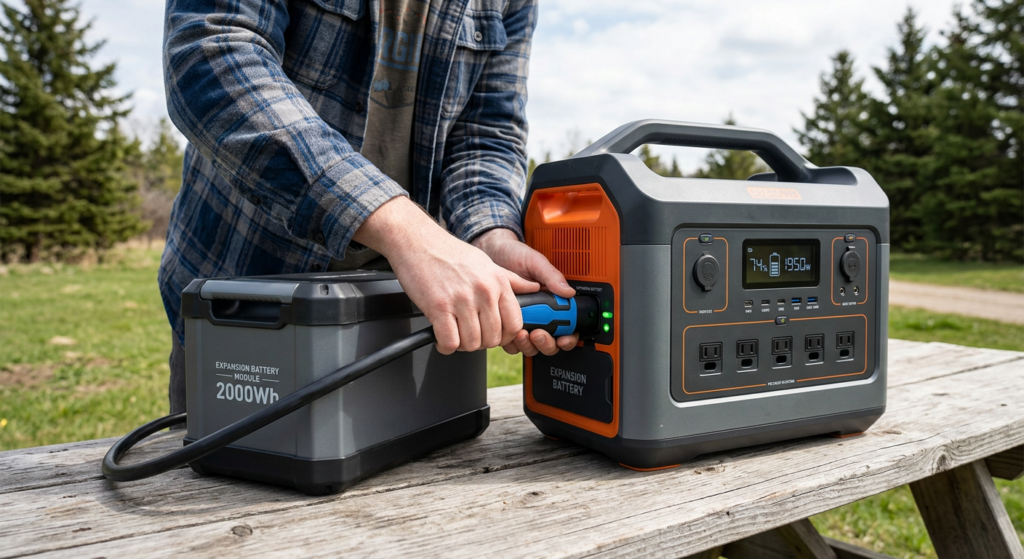
| Bluetti | AC200MAX | 2,048Wh | $600–$800 | Expansion battery serves as replacement |
| Bluetti | EB3A | 268Wh | $150–$200 | Limited availability |
| Jackery | Explorer 1000 Pro | 1,002Wh | $450–$600 | Service center required |
| Jackery | Explorer 2000 Plus | 2,042Wh | $800–$1,000 | Modular system; buy expansion |
| Anker | 757 PowerHouse | 1,229Wh | $500–$650 | Post-warranty service available |
| Goal Zero | Yeti 1500X | 1,516Wh | $700–$900 | Authorized service only |
Critical notes on power station battery replacement cost:
- Prices shown are battery module only (labor extra if required)
- Warranty replacement often free or heavily discounted if defect proven
- Out-of-warranty replacement typically 40–60% of current new unit price
Budget/mid-tier brands (replacement options limited or nonexistent)
Many budget brands offer no official power station battery replacement cost program:
| Brand | Model class | Replacement service |
|---|---|---|
| Rockpals | 500W class | No official program; DIY only option |
| ALLPOWERS | S2000 | Contact support (inconsistent availability) |
| GRECELL | 1200W | No battery-only replacement offered |
| Westinghouse | iGen portable | No separate battery service; full unit only |
For these brands, power station battery replacement cost often means sourcing third-party cells and doing DIY installation—or buying a new unit entirely.
Related buying guides: portable power station buying guide and how to read portable power station reviews.
DIY battery replacement: feasibility, actual cost, and real risks
DIY replacement can dramatically reduce power station battery replacement cost, but introduces warranty and safety considerations.
DIY feasibility by unit design
| Design architecture | DIY difficulty | Cost savings potential | Safety risk level |
|---|---|---|---|
| Modular plug-in expansion | Easy (literally plug and play) | Moderate (still buying official module) | Low |
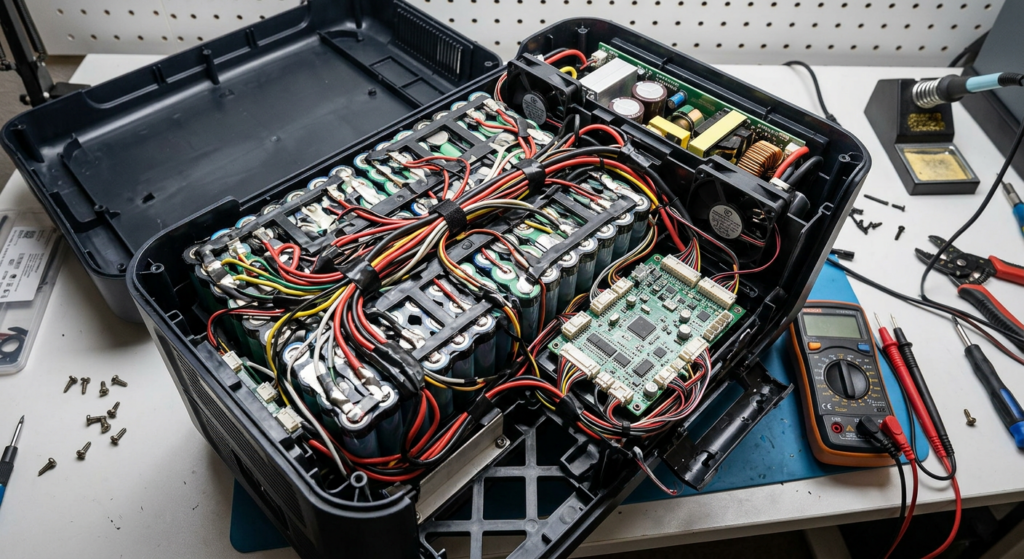
| Screwed/bolted battery pack | Moderate (requires disassembly) | High (third-party cells viable) | Moderate |
| Welded/sealed enclosure | Hard to impossible | Variable | High (serious damage risk) |
Modular designs (lowest power station battery replacement cost DIY option)
Some premium units use expansion batteries that simply plug in. If the main battery fails, buy an expansion battery and designate it as primary.
Examples:
- EcoFlow DELTA Pro: Extra battery modules available ($1,200–$1,500)
- Bluetti AC200MAX: B230/B300 expansion batteries can replace internal
- Jackery Explorer 2000 Plus: Fully modular; just swap battery packs
Real power station battery replacement cost: Same as official, but you can hunt sales or used markets for savings.
Screwed/serviceable units (moderate DIY complexity)
Some designs use screws and standard connectors, making battery pack swaps feasible with proper tools and knowledge.
What DIY replacement requires:
- Correct replacement pack (exact voltage, capacity, BMS protocol match)
- Basic tools (precision screwdrivers, spudgers, multimeter)
- Safety equipment (insulated gloves, eye protection, fire extinguisher)
- Technical knowledge (DC wiring, polarity verification, BMS communication)
Typical DIY power station battery replacement cost breakdown:
- Third-party LiFePO4 pack (1,000Wh class): $250–$400
- Third-party NCM pack (1,000Wh class): $200–$350
- Tools and safety materials: $20–$50
Total DIY savings versus official: 30–50% reduction in power station battery replacement cost
Real risks you’re accepting:
- Voiding manufacturer warranty (almost guaranteed)
- BMS incompatibility causing errors or fire hazard
- Accidental damage to other components during disassembly
- Zero manufacturer support if problems occur post-replacement
Related safety context: portable power station fire safety apartment and charge portable power station inside apartment safe.
Sealed/welded units (DIY not recommended for power station battery replacement cost savings)
Some units permanently bond the battery assembly into the case with adhesive or welds.
DIY approach requires:
- Destructive case opening (often destroys weatherproofing)
- De-soldering or cutting battery connections (fire risk)
- Installing new pack with improvised mounting
- Reassembly with epoxy/adhesive (can’t restore factory quality)
Why DIY here is dangerous:
- Extremely high risk of cell short-circuit during disassembly
- Fire and explosion hazard from improper handling
- Impossible to achieve original safety standards
- Will fail any safety inspection
For sealed units, power station battery replacement cost via DIY is simply not worth the danger.
The “worth it or not” calculation (structured decision framework)
Here’s how to mathematically determine if power station battery replacement cost makes financial sense.
Step 1: Calculate replacement cost ratio
Replacement ratio = (Battery replacement cost ÷ Current new unit price) × 100
Universal decision thresholds:
- Below 40%: Replacement usually makes financial sense
- 40–60% range: Borderline; other factors decide
- Above 60%: Generally better to buy new unit
Real example 1:
- Unit: EcoFlow DELTA 2 (current new price $899)
- Official power station battery replacement cost: $450
- Ratio: 450 ÷ 899 = 50.1%
- Assessment: Borderline case; evaluate other factors
Real example 2:
- Unit: Jackery Explorer 1000 Pro (current price $999)
- Official replacement: $550
- Ratio: 550 ÷ 999 = 55.1%
- Assessment: Leaning toward “buy new”
Real example 3:
- Unit: Bluetti AC200MAX (current price $1,599)
- B230 expansion as replacement: $1,299
- Ratio: 1,299 ÷ 1,599 = 81.2%
- Assessment: Strongly favor buying new (or newer model)
Step 2: Factor in remaining component value
Even with dead battery, your power station contains valuable components:
- Pure sine wave inverter (often $200–$400 value)
- MPPT solar charge controller
- Display and control electronics
- All output ports and wiring
- Durable case and construction
If these components remain fully functional, power station battery replacement cost analysis tilts toward replacement being worthwhile.
Step 3: Account for technology advancement
If your unit is 3–5+ years old, newer models often deliver:
- Superior battery chemistry (longer cycle life)
- Dramatically faster charging technology
- More efficient inverter designs
- Higher-watt USB-C PD ports
- Better smartphone app control
- Reduced weight for equivalent capacity
Practical rule:
If unit age exceeds 4 years and power station battery replacement cost exceeds 50% of new equivalent, buying new typically delivers meaningfully better technology.
Step 4: Warranty and support status impact
| Current warranty status | How it affects power station battery replacement cost decision |
|---|---|
| Active warranty + capacity below 80% | File warranty claim; replacement often free or minimal cost |
| Just expired (<6 months past warranty) | Contact support; goodwill replacements sometimes offered |
| Out of warranty 1–2 years | Replacement viable if ratio below 50% |
| Out of warranty 3+ years | Strong bias toward buying new technology |
For warranty claim strategies and what’s actually covered, see portable power station review checklist.
Real-world replacement scenarios (worked examples with actual power station battery replacement cost)
Scenario 1: EcoFlow DELTA 2 (2 years old, 65% capacity retention)
Current situation:
- Original purchase: $999 two years ago
- Current capacity: ~665Wh instead of rated 1,024Wh (65% retention)
- Warranty expired
- Current new DELTA 2 price: $899
Power station battery replacement cost options:
- Official EcoFlow battery replacement: $450
- Buy brand new DELTA 2: $899
- Upgrade to DELTA 2 Max: $1,399
Financial analysis:
- Replacement ratio: 450 ÷ 899 = 50.1%
- Inverter, charge controller, all ports still excellent condition
- Technology unchanged in past 2 years (same generation)
Decision: Replace the battery. You save $449 versus buying new, inverter and all other components remain fully functional, and if you plan another 3+ years of use, power station battery replacement cost of $450 delivers solid value.
Scenario 2: Jackery Explorer 1000 (4 years old, 70% capacity)
Current situation:
- Original purchase: $999 four years ago
- Current capacity: ~700Wh instead of rated 1,002Wh
- Well past warranty expiration
- Current new Explorer 1000 v2 price: $849
Power station battery replacement cost options:
- Official Jackery battery service: $550
- Buy new Explorer 1000 v2: $849
- Upgrade to Explorer 1500 Pro: $1,199
Financial analysis:
- Replacement ratio: 550 ÷ 849 = 64.8%
- 4-year-old technology; v2 has improved USB-C PD, better BMS
- Power station battery replacement cost approaches two-thirds of new price
Decision: Buy new Explorer 1000 v2. For only $299 more than battery replacement, you receive brand-new unit with full warranty, upgraded USB-C technology, and improved battery management. The power station battery replacement cost isn’t justified at 65% of new unit price.
Scenario 3: Bluetti EB3A (1 year old, 50% capacity—suspected defect)
Current situation:
- Purchased 13 months ago for $249
- Catastrophic capacity drop to ~134Wh (50% retention) in first year
- Still within 2-year warranty period
- Visible battery case swelling observed
Power station battery replacement cost options:
- Warranty claim filing: $0–$50 (likely free)
- Out-of-warranty official replacement: $150–$200
- Buy brand new EB3A: $249
Analysis:
- Rapid first-year degradation strongly indicates manufacturing defect
- Battery swelling represents safety hazard
- Unit still under manufacturer warranty
Decision: File warranty claim immediately. This is textbook defective battery behavior. Bluetti should provide free or nominal-cost replacement. Do not continue operating a swollen battery—safety risk. Power station battery replacement cost should be zero under warranty.
Related chemistry safety: LiFePO4 vs NMC apartment safety.
Scenario 4: Goal Zero Yeti 1500X (3 years old, 75% capacity)
Current situation:
- Purchased 3 years ago for $1,999
- Current capacity: ~1,137Wh instead of rated 1,516Wh
- Out of warranty
- Current new Yeti 1500X price: $1,899
Power station battery replacement cost options:
- Authorized Goal Zero service replacement: $800
- Buy new Yeti 1500X: $1,899
- Switch to competitor (EcoFlow DELTA Pro): $2,499
Analysis:
- Replacement ratio: 800 ÷ 1,899 = 42.1%
- Goal Zero reputation for exceptional durability; rest of unit likely excellent
- Newer competitors offer better value but incompatible ecosystem
Decision: Replace the battery. At 42% of new unit cost, you save $1,099 versus buying new and retain a proven reliable platform. If you’re invested in Goal Zero solar panels and accessories, power station battery replacement cost of $800 makes strong financial sense.
How to source batteries for replacement (official vs third-party channels)
Official manufacturer direct channels
Advantages:
- Guaranteed 100% compatibility
- Warranty coverage on replacement battery
- Professional installation guidance available
- Tested and certified safe
Disadvantages:
- Highest power station battery replacement cost
- Limited availability for discontinued models
- May require shipping entire unit to service center
Ordering process:
- Contact manufacturer support with exact model and serial number
- Request detailed power station battery replacement cost quote
- Verify if self-installation permitted or service center required
- Order and carefully follow provided installation instructions
Authorized third-party service centers
Brands like Goal Zero, Jackery, and EcoFlow maintain networks of authorized repair facilities.
Advantages:
- Professional certified technicians
- Genuine manufacturer parts guaranteed
- Warranty coverage on performed work
Disadvantages:
- Power station battery replacement cost includes labor ($50–$150 typically)
- Longer turnaround time (1–3 weeks common)
- Geographic availability varies significantly
Third-party battery suppliers (DIY route)
For units with accessible battery compartments, aftermarket LiFePO4/NCM packs exist.
Where to source:
- Alibaba/AliExpress (bulk lithium cell suppliers)
- Specialty battery retailers (18650 Battery Store, Battery Hookup, others)
- DIY electronics forums (vetted supplier recommendations)
Advantages:
- Dramatically lower power station battery replacement cost (30–50% savings)
- Ability to customize capacity or upgrade chemistry
- Complete control over replacement process
Disadvantages:
- Compatibility risk (voltage mismatch, BMS protocol, connector type)
- Zero manufacturer technical support
- Significant safety risk if cells counterfeit or improperly matched
- Immediate warranty void
Critical safety warning:
Only pursue third-party batteries if you possess genuine electrical knowledge and can independently verify cell authenticity, voltage specifications, and BMS compatibility. Mistakes can cause catastrophic fire.
If you choose official replacement but cannot safely DIY, expect additional labor charges.
| Service complexity | Typical labor cost | Estimated time required |
|---|---|---|
| Simple modular swap | $0–$50 | Under 1 hour |
| Standard screwed pack replacement | $100–$200 | 1–2 hours |
| Complex disassembly with soldering | $200–$400 | 2–4 hours |
DIY value:
If you can safely perform replacement yourself, you eliminate labor costs entirely—potentially saving $100–$400 on total power station battery replacement cost.
When NOT to replace the battery (money-wasting red flags)
Sometimes replacement is financially irrational even if technically possible.
Avoid battery replacement if:
- Power station battery replacement cost exceeds 60% of equivalent new model
You’re better off buying new with full warranty coverage. - Unit exhibits multiple system failures beyond just battery
If inverter, charge controller, or BMS also failing, you’re investing in a fundamentally compromised platform. - Any safety issues present (swelling, physical damage, thermal events)
These indicate systemic problems; battery replacement won’t address root causes. - Technology age exceeds 5 years
Newer models are often dramatically superior; you’d be upgrading to obsolete technology. - Original manufacturer no longer exists or supports model
No parts pipeline, no technical support—extremely risky power station battery replacement cost investment. - You lack confidence in your technical ability for DIY path
Lithium battery work is NOT “learn as you go.” Errors can cause fires.
Related fire safety context: portable power station fire safety apartment.
The repair vs replace decision tree (framework you can follow)
textSTART: Is your battery showing degradation symptoms?

↓ YES

Current capacity retention above 75%?
 ├─ YES → Continue using; implement prevention strategies
 └─ NO → Proceed to next check

Unit still covered by active warranty?
 ├─ YES → File warranty claim (likely $0 power station battery replacement cost)
 └─ NO → Proceed to cost analysis

Calculate: Battery replacement cost ÷ New unit current price
 ├─ Result <40% → Strong candidate for replacement
 ├─ Result 40–60% → Borderline; evaluate additional factors below
 └─ Result >60% → Lean toward purchasing new

Unit age less than 3 years?
 ├─ YES → Replacement more attractive (current technology)
 ├─ NO → Buying new more attractive (technology advancement)

Are inverter/charge controller/other systems fully functional?
 ├─ YES → Replacement remains viable option
 └─ NO → Buy new (multiple failing systems)

Do you possess DIY technical ability plus required tools?
 ├─ YES → DIY replacement can reduce power station battery replacement cost 30–50%
 └─ NO → Must factor professional labor cost ($100–$400)

FINAL RECOMMENDATION:
→ Replace battery if: Cost <50% of new, age <3 years, other systems healthy
→ Buy new unit if: Cost >60% of new, age >4 years, or significant tech advancement
→ Warranty claim if: Still covered and degradation abnormal
The bottom line on power station battery replacement cost
Power station battery replacement cost spans from $150 for small units to $1,500+ for large-capacity models. Whether replacement makes financial sense depends on five key factors:
- Cost ratio (below 40% of new unit = strong replacement candidate)
- Unit age (under 3 years = replacement viable; over 5 years = favor new purchase)
- Other component condition (healthy inverter/BMS/ports support replacement decision)
- Technology advancement (newer models may deliver substantially better performance)
- Your technical capability (DIY dramatically reduces power station battery replacement cost but requires real skill)
General guidance by user type:
- Premium modular battery systems: Replacement often financially sound
- Budget brands without official support: Usually better to buy new
- Mid-life units (2–4 years) with sub-50% replacement cost: Replace
- Older units (5+ years) with above-50% cost: Buy new technology
Action items (what to do right now)
- Test actual current capacity: Perform constant-load discharge test to measure real remaining Wh
- Request official quote: Contact manufacturer for precise power station battery replacement cost
- Calculate cost ratio: Divide replacement cost by current new unit market price
- Verify warranty status: File claim immediately if still covered and degradation abnormal
- Research newer models: Compare current specs to evaluate if technology has meaningfully advanced
- Make decision: Apply decision tree framework above to your specific situation
For capacity testing methodology, see calibrate portable power station battery.
For purchasing new with longevity priority, consult portable power station buying guide and best portable power station reviews.
- Battery replacement safety protocols: U.S. Department of Energy Battery Safety
- DIY battery construction education: Battery University
- Consumer warranty legal rights: FTC Warranty Guide